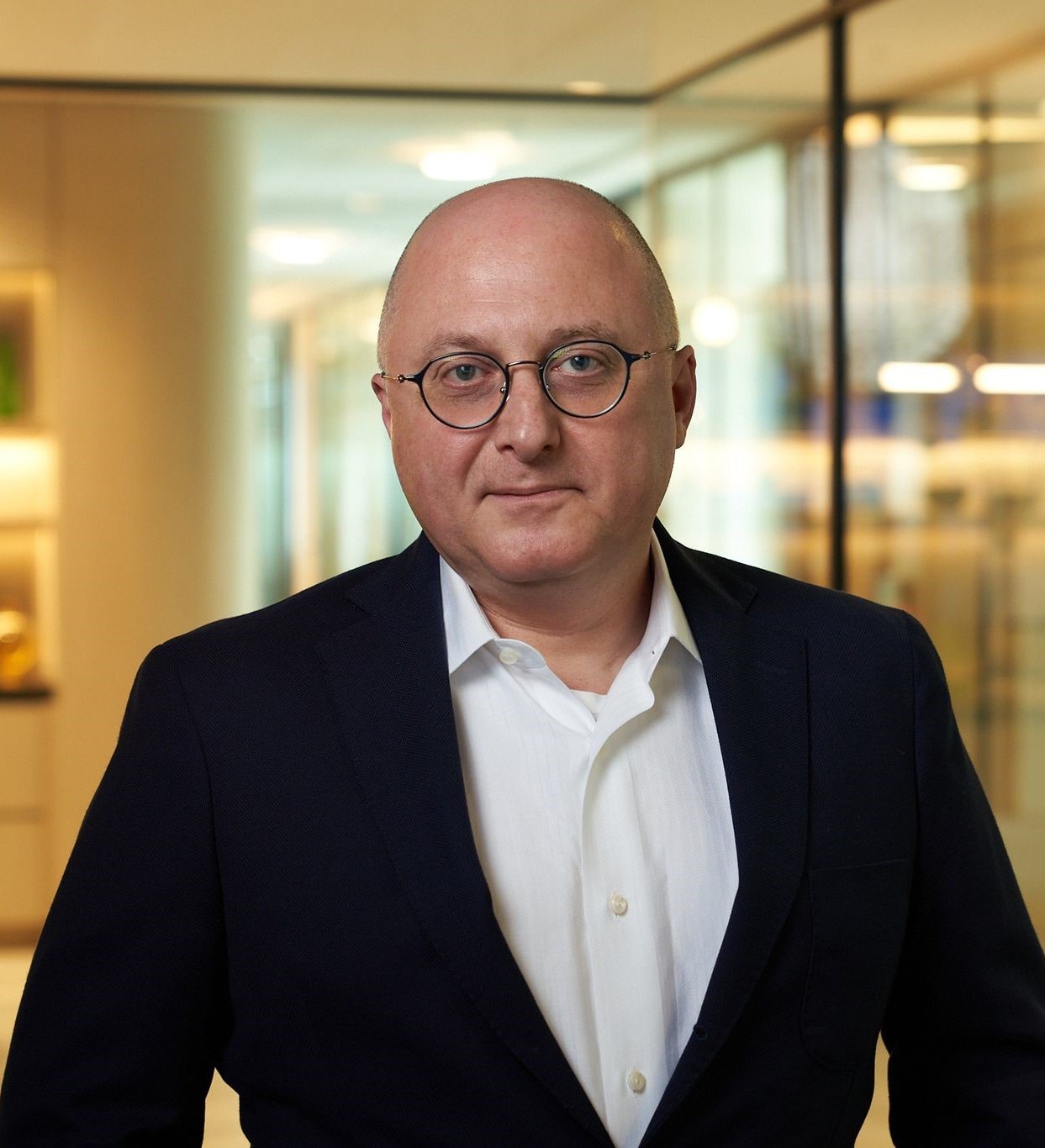
I learn the science first. Then I write the claims.
Services
Technologies
Alexander Akhiezer is a Boston patent attorney, registered with the USPTO, who works with research universities, startups, venture capital investors and public companies across the United States and abroad on technology commercialization: patent strategy and prosecution, licensing, IP portfolio development and life-cycle management, IP matters in acquisitions, and opinions on infringement and validity.
His focus is emerging technologies at the intersection of physics, chemistry and biology, including quantum computing, photonics, energy, advanced materials and drug discovery. He holds a Ph.D. in biological and computational chemistry from MIT, where his research used small molecules to dissect protein kinase signaling pathways and developed new structure-based drug design methods, and a J.D., cum laude, from Suffolk University Law School. Before graduate school he was a scientist in the protein chemistry department at ImClone Systems.
His training in theoretical physics and chemistry lets him work through the technology with researchers before a word of an application is written.
Choosing a patent attorney in Boston
Patent practice before the U.S. Patent and Trademark Office is federal, so your patent attorney does not have to be in your state. Alexander is based in Boston and works with clients across the United States, as well as companies and universities in Israel, Europe and Asia that seek U.S. patents. For deep-tech founders, university spin-outs and R&D teams, five questions narrow the field quickly:
- Does the attorney understand your science? Alexander holds a Ph.D. from MIT and trained in theoretical physics, so the first conversation is about how your technology works and what is actually new.
- Who will write the application? In a solo practice, the attorney you talk to is the one who drafts the claims and answers every office action.
- Has the attorney worked in your field? His matters include neutral-atom quantum computing, silicon photonics, fuel cell membranes, clean hydrogen, fusion and AI-based diagnostics. See the representative experience below.
- Will the filings fit your business? Filing dates should track publications, product launches and your next financing. See when to file a patent application.
- Can the attorney help beyond filing? He also advises on university licenses, IP diligence for financings and acquisitions, and opinions on infringement and validity. See practice.
Alexander works with research universities, startups and spin-outs, venture capital investors and public companies, in Massachusetts, nationwide and internationally. Meetings can take place in person in Greater Boston or by video.
Credentials
Admissions and registration
- U.S. Patent and Trademark Office, Reg. No. 54617
- U.S. District Court for the District of Massachusetts
- U.S. Court of Appeals for the Federal Circuit
Education
- Ph.D., Biological and Computational Chemistry, Massachusetts Institute of Technology
- J.D., cum laude, Suffolk University Law School
- B.A., Chemistry, summa cum laude, New York University
- Diploma with Distinction, Theoretical and Mathematical Physics, Kharkiv University
Representative experience
Matters are described in general terms to protect client confidentiality.
- Patent prosecution counsel for a research university’s licensed portfolio on quantum computers using neutral-atom qubits
- Patent prosecution counsel for a research university’s silicon photonics portfolio
- Patent prosecution counsel for a company developing a thermodynamic computer
- Patent prosecution counsel for a drug discovery company’s portfolio on AI-based diagnostic tools
- Patent prosecution counsel for a company developing fuel cell membranes
- Patent prosecution counsel for a company developing clean hydrogen production technology
- Patent prosecution counsel for a company developing novel fusion technology
- Participated in licensing negotiations between a major research university and a multinational corporation
- Advised a biotechnology startup in licensing negotiations with a global life sciences and diagnostics company
- Represented a party in major litigation involving a biotechnology device
- Advised a research university on deconflicting sponsored-research agreements
Recognition
- Best Lawyers in America, Patent Law, 2023–2027
- Paul and Daisy Soros Fellowship for New Americans, a national fellowship for first-generation Americans who have shown creativity and persistence in achieving leadership in their fields
Community + pro bono
- Judge, MedTech and Digital Health startup competition, evaluating a cohort of early-stage startups
Presentations + publications
Talks
- The Convergence Quantum Spotlight, 2026
- Panelist, patent issues in quantum computing, IEEE Quantum Week 2026
Publications
- Co-author with Erik Huestis, “Quantum Computing’s ‘Picks-and-Shovels’ Moment: What the New U.S. Executive Orders Signal for IP,” WIPR (World IP Review), 2026
- “Total Synthesis and Immunosuppressive Activity of Pateamine A and Related Compounds,” Journal of the American Chemical Society 120 (1998) 12237–12254
- “An Exactly Solvable System of Coupled Non-Linear Schrödinger Equations,” Physics Letters A 182 (1993) 44–48
- “Optimization of Molecular Shape and Charge in Rational Drug Design,” doctoral thesis, MIT
- Articles and videos on this site: Blog and Videos