Hydrogen patents: membranes, catalysts and process know-how
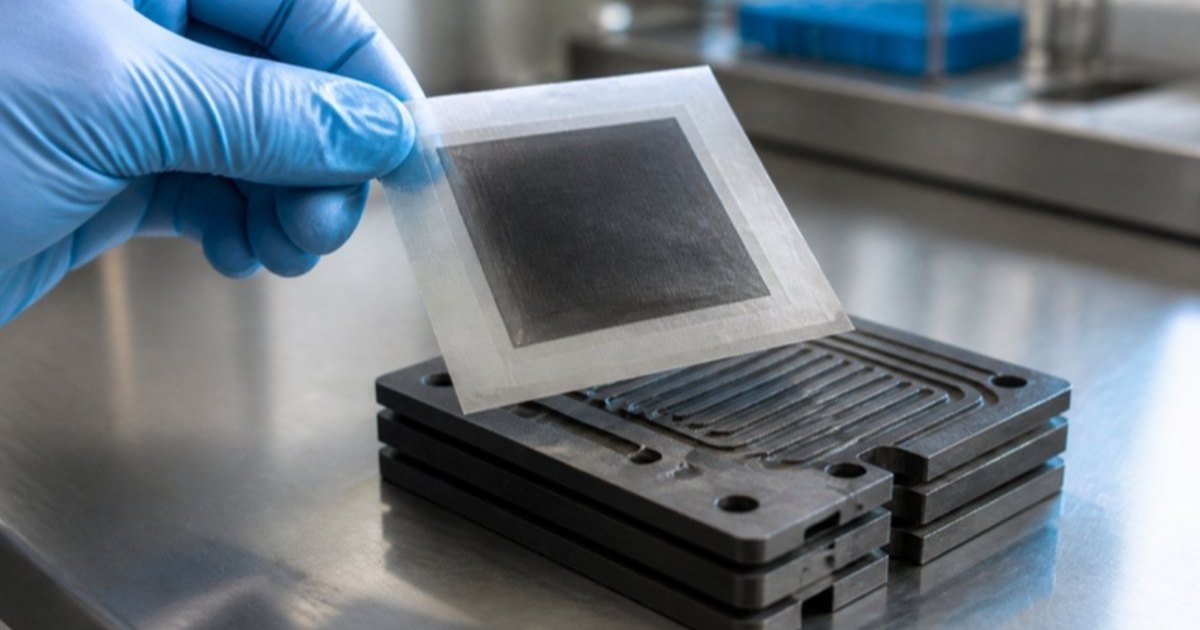
A strong hydrogen patent usually protects one of four things: the membrane, the catalyst, the way the stack and system are put together, or the process used to make them. In fuel cells and electrolyzers, those layers carry most of the value and most of the competition. Which ones you patent, and which you keep secret, should follow from what a competitor could see by taking your product apart.
This article is for clean-tech founders and the investors who back them. I cover where patents matter most in hydrogen production and fuel cells, how composition-range claims hold up against a crowded prior art record, how to search that record before you file, and when process know-how is better kept as a trade secret. It reflects U.S. law and USPTO practice as of October 2026.
Key takeaways
- Patent what can be seen or tested. Membrane chemistry, catalyst composition and stack architecture can be read from a competitor’s product, so patents can be enforced against them.
- Ranges are fragile. A single prior-art example inside your claimed range defeats novelty, and an overlapping range creates a presumption of obviousness.
- Show why your range is critical. Comparative data at and beyond the edges of the range is what rebuts that presumption.
- Search fuel cell and electrolyzer art together. Membrane and catalyst work in one often anticipates claims in the other.
- Hidden process steps may be better as trade secrets, but only with real secrecy measures and a plan for the day someone else patents the same step.
Where does a hydrogen patent matter most?
A hydrogen patent matters most where three things meet: a real performance or cost gain, a feature a competitor cannot easily avoid, and a feature you can detect in their product. In fuel cells and electrolyzers, that usually means the membrane, the catalyst layer, the stack and system design, and the manufacturing steps that make them work at scale.
The Department of Energy’s overview of hydrogen production by electrolysis describes proton exchange membrane (PEM), alkaline, anion exchange membrane (AEM) and solid oxide designs, the last with a ceramic electrolyte at about 650°C to 850°C. A PEM fuel cell uses the same membrane chemistry in reverse, which shapes both your claims and your search.
Membranes
Membrane claims are usually composition and structure claims: an ionomer with a defined equivalent weight, a reinforced composite of stated thickness, a radical scavenger at a stated loading. A competitor’s membrane can be analyzed in a lab, which helps enforcement. But the literature on ion-conducting polymers is deep.
Catalysts and electrodes
Catalyst claims often aim to reduce or replace platinum-group metals: a lower-loading iridium oxide anode for PEM electrolysis, a platinum alloy fuel cell cathode, or a platinum-group-metal-free catalyst for AEM systems. The claim defines composition, particle structure and loading. An unexpected result (activity or durability the trend did not predict) is often the most valuable fact in the application.
Stack and system integration
Stack claims cover bipolar plate flow fields, seals, porous transport layers, compression and cooling. System claims cover how the stack works with power electronics, water management and a variable renewable power supply. They are easy to read on a competitor’s product but can be designed around if drafted too narrowly.
Manufacturing processes
Process claims cover coating, casting, sintering and assembly steps: how you deposit a thin catalyst layer, how you cast a membrane without defects, how you co-sinter a solid oxide cell. These steps often decide unit cost, and they are the hardest to police.
| Layer | Typical claim subject | Can you detect infringement? | Usual first choice |
|---|---|---|---|
| Membrane | Ionomer composition, reinforcement, additives | Usually, by lab analysis | Patent |
| Catalyst and electrode | Alloy or oxide composition, loading, layer structure | Usually, by microscopy and composition analysis | Patent |
| Stack | Flow fields, seals, transport layers, compression | Yes, by teardown | Patent |
| System and controls | Integration with power supply, water and heat management | Partly, from product literature and testing | Patent, with careful drafting |
| Manufacturing process | Coating, casting, sintering and assembly conditions | Often not | Case by case; often trade secret |
I have handled prosecution for companies developing fuel cell membranes and clean hydrogen production, and the pattern holds across both: the best claims track what a competitor’s product will reveal. More on this work is on my advanced materials practice page.
How do composition-range claims work in a hydrogen patent?
A composition-range claim defines an invention by numbers: a loading in milligrams per square centimeter, a thickness in microns, a dopant percentage. In a crowded field, ranges are especially exposed. Prior art that discloses a single point inside your range anticipates the claim, and prior art with an overlapping range makes the claim presumptively obvious.
Anticipation means one prior-art reference already discloses everything in the claim, so it is not new under 35 U.S.C. § 102. Obviousness under § 103 means a person of ordinary skill would have arrived at the invention from known teachings.
The rules for ranges
- A point inside your range anticipates. Under MPEP 2131.03, “If the prior art discloses a point within the claimed range, the prior art anticipates the claim.” One example in a 2015 paper can be enough.
- An overlapping range may anticipate if the prior art describes your range with “sufficient specificity.” That is decided case by case, and a showing that your narrow range is critical helps.
- Overlapping or nearby ranges are presumptively obvious. Under MPEP 2144.05, overlap creates a prima facie case of obviousness (a presumption the applicant must then answer), and so can ranges that are merely close.
- Routine optimization is not invention where the general conditions are known, unless the claimed range is critical.
How to rebut: criticality and unexpected results
The MPEP lists three main answers. You can show that the claimed range is critical, generally through unexpected results compared with the prior-art range. You can show that the prior art taught away from your range. Or you can show that the variable was not recognized as result-effective at all, meaning nobody knew it controlled the property you care about. A difference in kind persuades more than a difference in degree.
Take a hypothetical PEM electrolyzer anode. The prior art discloses iridium oxide catalyst layers at a broad range of loadings. You find that, within a narrow band of loadings combined with a particular ionomer content, degradation over a long test drops sharply rather than gradually. That fact supports a range claim, but only if the application contains the data: test points inside, at the edges and outside the range, under the same conditions.
A claim to a broad family of compositions must also be enabled across its whole scope, as I explain in materials patent enablement after Amgen v. Sanofi. The practical answer is a ladder of claims: a broad claim defined by a rule that predicts performance, then narrower claims down to the composition you will actually sell.
Europe applies its own framework to ranges. The European Patent Office treats them under a separate heading in its examination guidelines, “Selection inventions” (Part G, Chapter VI, section 7 of the 2026 edition). Do not assume a range strategy that works at the USPTO will work there; plan the data for both.
How do you search prior art in a crowded hydrogen field?
Search patents and the scientific literature together, organized by patent classification codes rather than keywords alone. Hydrogen and fuel cell art is large and old, much of it is in Japanese, Korean, German or Chinese filings, and the same membrane or catalyst idea often appears first in a neighboring application.
The field is busy. A January 2023 study by the European Patent Office and the International Energy Agency, Hydrogen patents for a clean energy future, found that EU countries held 28% of international patent families in hydrogen from 2011 to 2020, Japan 24% and the United States 20%. It reported that Japan leads in alkaline and PEM electrolyzer patenting and Europe is especially active in solid oxide electrolysis.
My search sequence before drafting:
- Write the inventive concept in one sentence. Name the material, the structure and the result. If you cannot, the search will drift.
- Search by Cooperative Patent Classification (CPC) code. Useful groups include C25B 1/04 (hydrogen by electrolysis of water), C25B 11/00 (electrodes), C25B 13/00 (diaphragms), H01M 4/86 and 4/90 (catalytic electrodes and catalyst selection), H01M 8/10 and 8/1004 (solid electrolyte fuel cells and membrane-electrode assemblies) and H01M 8/24 (stacking).
- Add the Y02E tags. Y02E 60/36 covers hydrogen production from non-carbon sources such as water electrolysis, and Y02E 60/50 covers fuel cells. They pull together documents classified elsewhere.
- Cross the fuel cell and electrolyzer lines. A membrane or catalyst disclosed for a fuel cell can anticipate the same composition claimed for an electrolyzer.
- Search full text in U.S. records. The USPTO’s Patent Public Search tool covers U.S. patents and published applications; use it for numbers and units (“mg/cm2”, “equivalent weight”) that classification misses.
- Search the non-patent literature. Journal articles, conference proceedings, theses and government lab reports are prior art too, and many range disclosures sit in a data table in a paper.
- Check your own disclosures. Your team’s papers, posters and grant reports count. The U.S. gives a one-year grace period for an inventor’s own disclosures; many other countries do not. See why the filing clock starts earlier than you think.
Patent or trade secret for hydrogen process know-how?
Patent process steps you can detect in a competitor’s product or that a competitor could learn by reverse engineering. Keep as trade secrets the steps that leave no trace in the product, such as exact coating conditions, annealing profiles or quality-control limits, but only if you can actually keep them secret. Many companies use both.
Each route has a cost. A patent application generally publishes about 18 months after its earliest filing date, so the process becomes public whether or not the patent issues. A trade secret lasts as long as it stays secret, but under the federal definition in 18 U.S.C. § 1839, the owner must take reasonable measures to keep it secret, and reverse engineering and independent derivation are not improper means. If a competitor works it out, you have no claim against them.
| Question | Points to a patent | Points to a trade secret |
|---|---|---|
| Can the step be seen in the finished product? | Yes, it leaves a measurable structure | No, the product looks the same either way |
| Can a competitor reverse engineer it? | Yes | No, or only with great effort |
| Will it be shared with suppliers or partners? | Widely | Rarely, under confidentiality terms |
| Do investors or acquirers need to see it? | A granted claim is easy to show | Needs documented secrecy controls |
Two U.S. rules shift the balance. First, under 35 U.S.C. § 271(g), importing or selling in the United States a product made by a process patented in the United States is infringement, unless the product has been materially changed by later processing or has become a trivial and nonessential component of another product. That gives a U.S. process patent reach over offshore production.
Second, if you keep a process secret and someone else later patents it, the prior commercial use defense in 35 U.S.C. § 273 may protect you. It requires good-faith commercial use in the United States at least one year before the other party’s effective filing date or public disclosure, proved by clear and convincing evidence. It is not a general license. Keep dated records of what you ran and when.
What do investors look for in a hydrogen patent portfolio?
Investors in hydrogen companies look for patents that cover the product being commercialized, clean ownership, and filings that match the markets where the company will sell. They also ask what is held back as a trade secret and how it is protected, and whether core work was filed before it was published.
The EPO and IEA study links patenting and financing directly. It found that over 80% of later-stage investment in hydrogen start-ups went to companies that had already filed a patent application. That is a correlation, not proof of cause, but it shows what this sector expects.
Geography deserves early thought. Much hydrogen patenting comes from Europe and Japan, and the EPO and IEA study found fast growth from Korea and China. The Patent Cooperation Treaty lets one international application keep options open across its contracting states while you decide where to spend. For the full list of diligence questions, see what investors ask about your patents.
Frequently asked questions
Can you patent a hydrogen electrolyzer?
Yes. You cannot patent electrolysis itself, but you can patent a new and non-obvious electrolyzer component, configuration or method of making it. Typical subjects include membrane compositions, catalyst layers with reduced precious metal loading, porous transport layers, stack designs and control methods tied to variable renewable power. The specification must teach how to make and use the full scope of the claims.
What makes a fuel cell membrane patentable?
A fuel cell membrane is patentable if its composition or structure is new and would not have been obvious from earlier membranes. Because the ionomer literature is large, the strongest membrane claims usually rest on data showing an unexpected result, such as durability or conductivity that the prior trend did not predict, tied to a specific composition, reinforcement or additive range.
Why are composition ranges rejected so often?
Because the rules for ranges favor the examiner. A single prior-art example inside your range anticipates the claim, and an overlapping or nearby prior-art range creates a presumption of obviousness. To overcome it, applicants usually need comparative data showing the claimed range is critical, or evidence that the prior art taught away from it or did not recognize the variable as important.
Should a hydrogen startup patent its manufacturing process?
Patent the process if the result can be detected in a competitor’s product, if the step can be reverse engineered, or if you plan to license it. Keep it as a trade secret if it leaves no trace in the product and you can control who knows it. Keep dated records either way, since they support a prior commercial use defense if someone else patents the same step.
Talk it through before you file
If you are deciding which parts of a membrane, catalyst or stack to patent before a raise or a partnership, I am happy to talk it through. I work with startups and university spin-outs at exactly that stage.
This article is general information, not legal advice, and reading it does not create an attorney-client relationship. Patent law changes and every situation differs. Please talk to a patent attorney about yours.